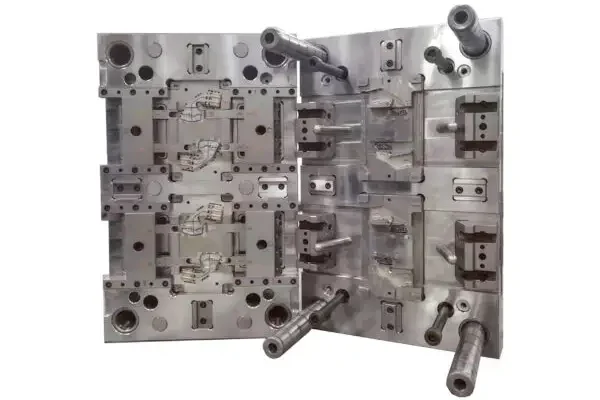
1.Key Metrics Demonstrating Strength
| Indicator | 2022 Actual | Year-over-Year Change | Global Ranking |
|---|---|---|---|
| Tooling Output | 26.31 million sets | +7.4% | No. 1 for 15 consecutive years |
| Tooling Market Size | RMB 346.8 billion | +12.6% | Accounts for 34% of the global total—larger than the combined US, Japan, and Germany markets |
| Tool-Steel Capacity | 2.46 million tonnes | +4% | Represents 42% of the world’s capacity; CR₅ = 92% |
Comparative Perspective
In a single year, China produces approximately 18% more dies and moulds than the combined output of the United States, Japan, Germany, South Korea, and Italy.
2.Geographic Distribution and Clusters
Three Main Poles & Three Major Belts
- Pearl River Delta: Responsible for approximately 45% of the nation’s plastic moulds, including those for phones and household appliances.
- Yangtze River Delta: Contributes around 30% of automotive stamping moulds; Ningbo’s “Mould Capital” alone accounts for 12%.
- Bohai-Rim / Central China: Produces about 20% of high-precision, high-cavity moulds.
Regional Clusters
- PRD (Dongguan, Shenzhen, Foshan): Hosts prominent manufacturers specializing in packaging and electronics moulds.
- YRD (Ningbo, Taizhou, Suzhou): Focused on car body panels and white-goods stamping; Ningbo’s logo signifies approximately 12% of the national market share.
3. Structure: plastic dominates, stamping follows
| Type | Share | Buzz words |
|---|---|---|
| Plastic moulds | 45 % | Auto light-weighting, metal-to-plastic shift |
| Stamping moulds | 37 % | EV motor housings, battery trays |
| Die-casting moulds | 9 % | Gigacast one-shot body |
| Others | 9 % | Powder-metal, rubber, glass |
One new-energy car needs RMB 18 k of tooling—42 % more than an ICE car. A 300 k-unit EV plant equals a RMB 5.4 billion tooling order [¹].
4. Utilisation: premium lines thirsty, low-end lines bleeding
- Average utilisation 78 %, but split:
– Precision medical multi-cavity, automotive-grade IC packages: >95 % booked, 3-month lead time;
– Commodity caps & closures: <60 % loaded, price war down to 8 % gross margin [¹][⁴]. - High-end self-sufficiency only 50 %: large car-tail-light, stacked OLED shadow masks still 100 % imported [⁴].
5. New capacity radar 2025-2027
| Region | Project | Investment | Killer spec |
|---|---|---|---|
| Ningbo Beilun | High-end auto stamping base | RMB 3.2 bn | 6 000 t try-out press |
| Dongguan Songshan Lake | Optical multi-cavity moulds | RMB 1.8 bn | 30 nm optical polish |
| Qingdao Jimo | Gigacast dies | RMB 1.5 bn | 12 000 T shot template |
| Chengdu Longquanyi | Battery-box FSW fixture | RMB 1.2 bn | Al-steel hybrid forming |
After ramp-up the four parks will add RMB 26 billion annual value—about Israel’s total mould output [³][¹].
6. Three hurdles from “biggest” to “strongest”
- Material bottleneck
40 % of premium tool steel imported; super-mirror FS136 costs RMB 28 k/t vs 14 k domestic, life doubled ; - Equipment gap30 000 rpm 5-axis spindles 90 % imported; laser-texturing machines 85 % German/Japanese ;
- Talent gap
Average age of master fitters 43; vocational enrollment down 35 % in five years—old-style apprenticeship drying up.
7. Take-away: biggest ≠ strongest, but big is the ticket to the strong game
China’s 26 million sets a year have squeezed the “scale dividend” dry. The next question is whether we can smelt more FS136 out of 2.46 million t of tool steel and crank out 30 000 rpm home-grown spindles from 98 machining lines—that is the final battle from “mould capital” to “mould superpower”.
After all, we are already seated at the table of the largest capacity; the chips we are betting now are technology iterations.
We are a Chinese leading company in the manufacture of tooling, stamping, injection molding, CNC machined parts. For any inquiries, reach out to us directly. We’re here to assist you.