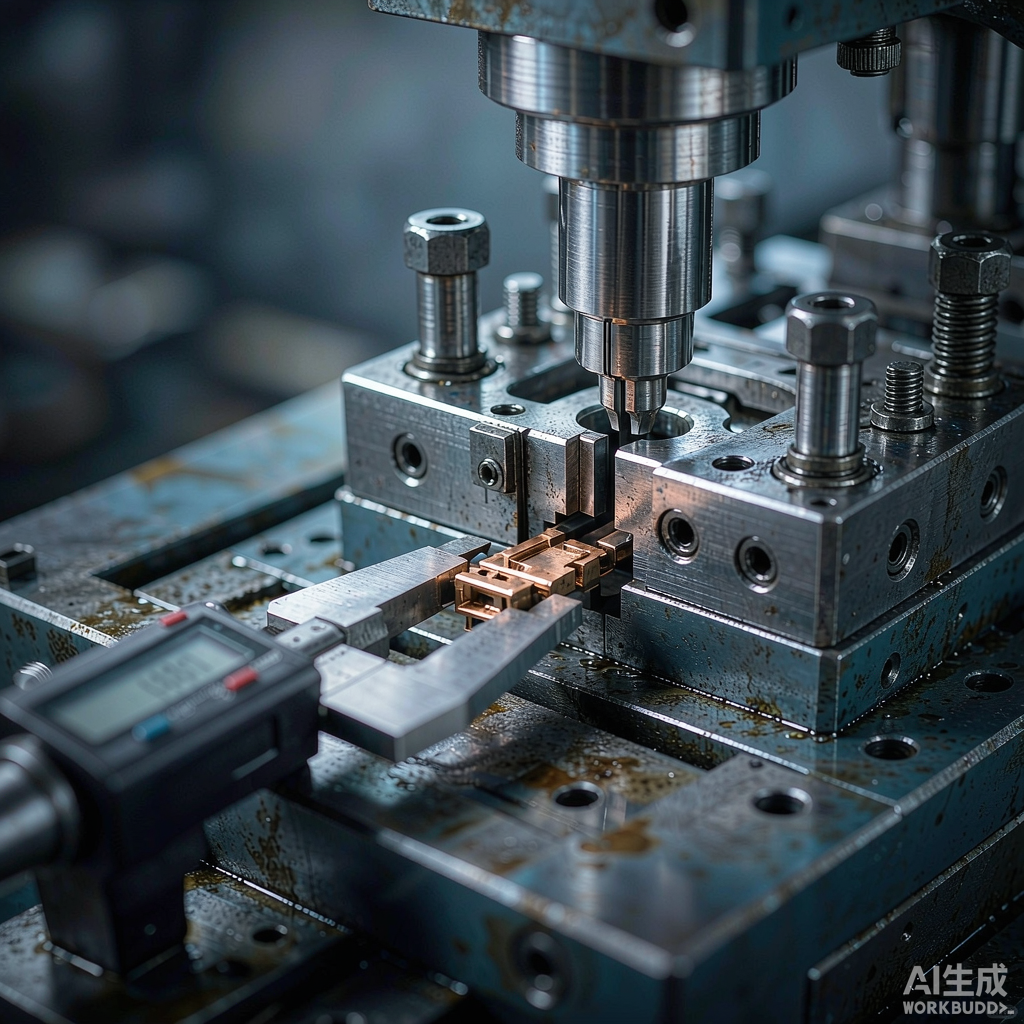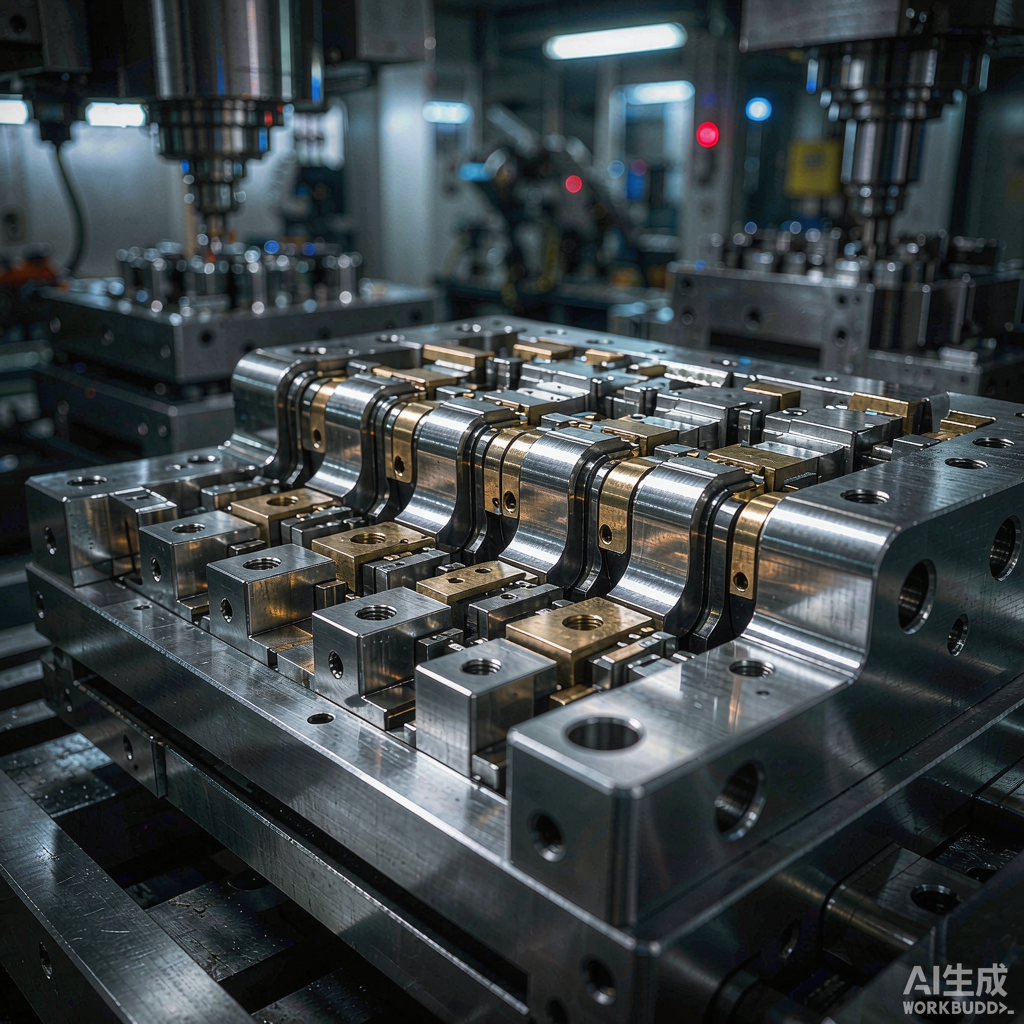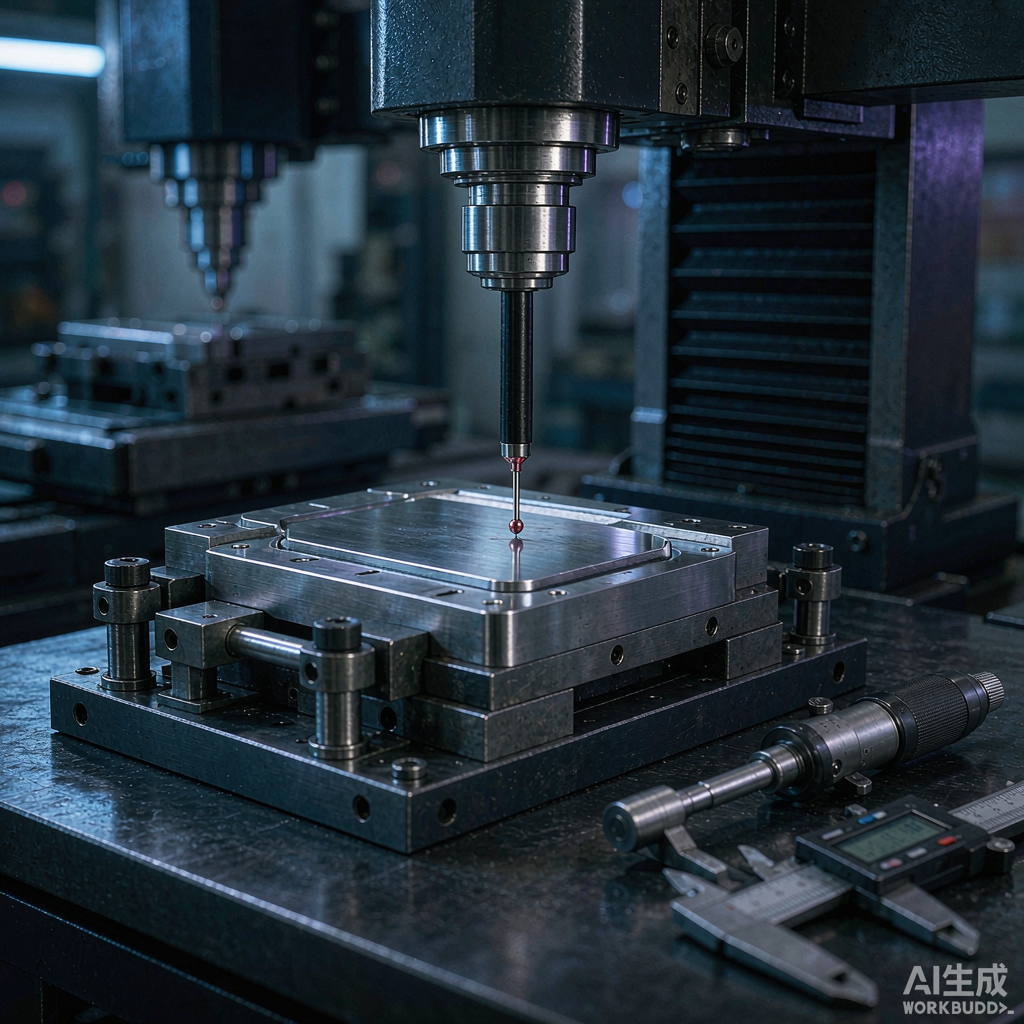
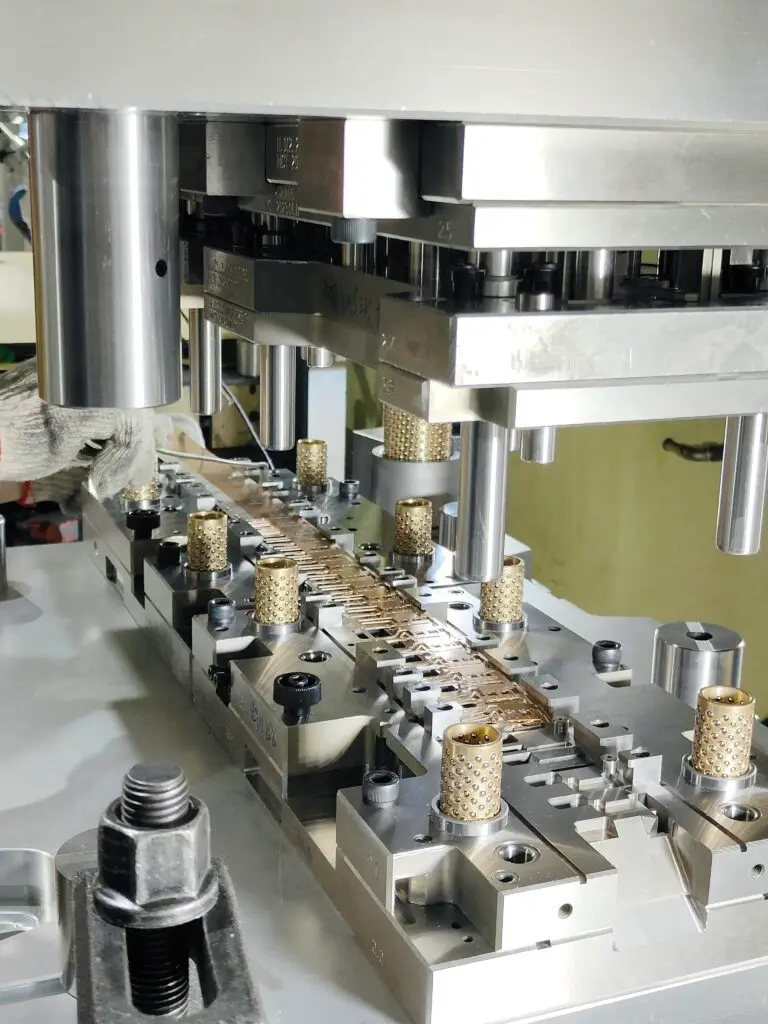
- Machining & Heat-treat (40 – 60 %) Everything that chips, sparks or glows: CNC roughing, high-speed finishing, wire / sinker EDM, jig grinding, vacuum hardening, PVD coating, laser welding.
Why the big spread? A 12-station 600 mm die with formed lances needs 3 000+ hours of machine time; a 4-station blank-and-form die for a USB shell takes <400 h. Five-axis high-feed cutters can cut roughing hours 30 %, but sinker-EDM of ribbed forms still eats budget. Rule of thumb: every 10 % reduction in machining hours drops total die cost ≈ 5 %.
- Material (20 – 40 %) a. Plates: pre-hardened P20 or S50C for die sets, 1.1730 for backup.
b. Insert steel: D2, M4, ASP-23, KD11NS, or tungsten-carbide (YG10X) for high-volume connectors.
c. Standard components: MISUMI, Dayton, Fibro, Danly, PUNCH—guide posts, bushings, gas springs, ball cages, keepers.
Material choice is a volume game. A carbide insert costs 6–8× D2 but lasts 20×; for 50 M parts/year the payback is obvious, for 2 M not so much.
- Engineering & Design (10 – 15 %) Blank development, forming simulation (AutoForm, Dynaform), strip layout, FMEA, GD&T drawings, revisions, APQP paperwork.
Paradox: it is the smallest line item yet locks >70 % of final cost. One extra station adds ~8 % to machining and 5 % to material. Do your math before the first mouse click.
- Try-out & Debug (5 – 10 %) Die spotting, press time (60–300 $/h), CMM scanning, slug inspection, rework, on-site customer buy-off.
High-strength steel or 0.08 mm thick beryllium-copper can push try-out to 12 %; soft aluminum laminations may stay at 3 %. Quick-change clamping and modular pilots shorten loop.
- Bench / Assembly (5 – 10 %) Hand fitting, stoning, polishing, lapping, back-boring dowels, setting clearances. Skilled fitters are scarce; hourly rates in North America and EU already >65 $/h. Automation (interchangeable inserts, pre-ground parallels) can halve bench hours.
- Overhead, Margin & Risk (5 – 10 %) Project management, financing, warranty, contingency for engineering changes.
Tool shops rarely book >8 % net profit; one major revision kills it. Hence the “EU surcharge” line you sometimes see.
- Freight & Packaging (1 – 3 %) Ocean crate, VCI bags, shock sensors, export docs. A 3-ton automotive die ships for ~2 500 toNA,1200 intra-Asia. Add 0.5 % insurance.
Quick Estimating Formulas Need a ball-park in the elevator?
Material-driven estimate
Die cost ≈ Raw material cost ÷ 0.30
(R² = 0.82 for 45 tools, strip ≤150 mm)
Weight-driven estimate
Die cost ≈ 17 $ × (die weight in kg)^0.85
Works for medium-precision steel tools, 500 k–5 M part life.
Cost-Reduction Levers That Actually Work
- Combine forming stations with in-die tapping or rotary cam → –1 station = –7 % cost.
- Use interchangeable insert pockets → 30 % less bench time.
- Switch from through-hardened D2 to coated PM-HSS only where wear occurs → –15 % material bill.
- Outsource rough machining to low-cost region, keep finish grind & try-out in-house → –8 % total.
- Print conformal-cooling inserts (AM) for high-speed runs → +4 % insert cost, –20 % try-out loops, net –3 %.
Key Take-away In a progressive stamping die you are not buying steel—you are buying machine hours and risk mitigation. Focus your negotiation on machining sequences, heat-treat specs and revision-control clauses; the material line will look after itself.
We are a Chinese leading company in the manufacture of tooling, stamping, injection molding, CNC machined parts. For any inquiries, reach out to us directly. We’re here to assist you.