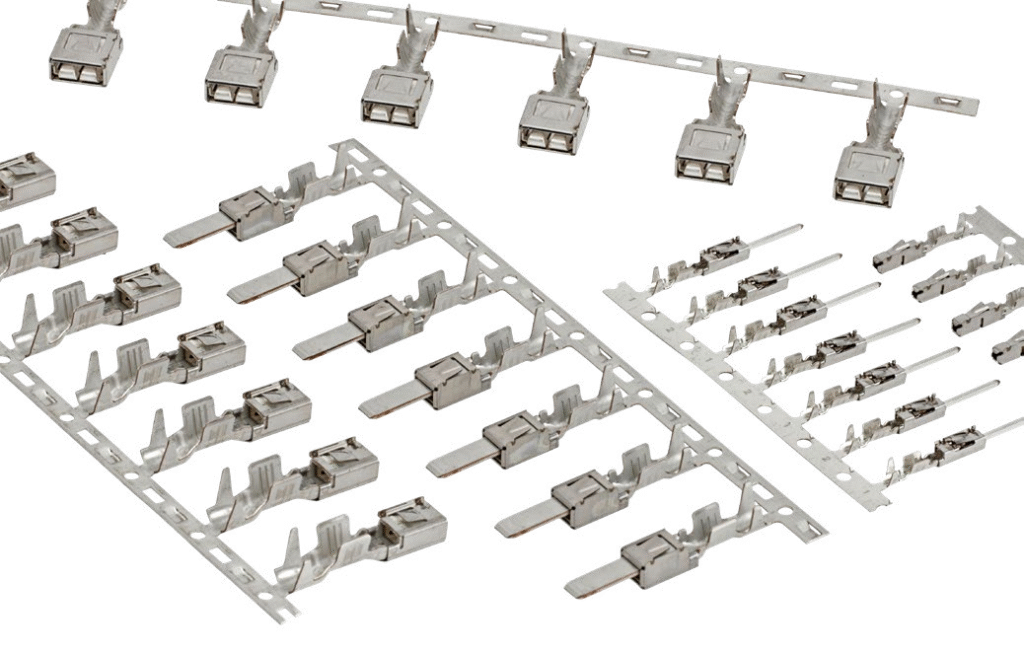
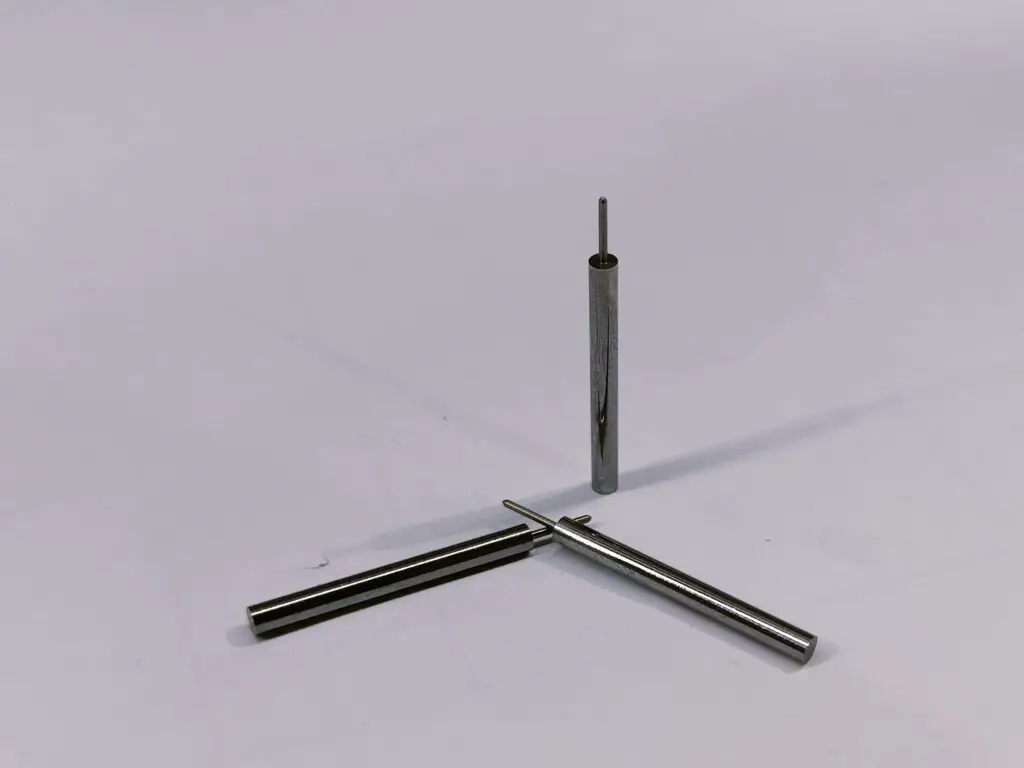
When stamping stainless steel, the wrong carbide choice doesn’t just wear out a tool—it grinds productivity and profit to a halt.
Stamping hard materials like stainless steel presents a unique triad of challenges: extreme abrasive wear from the material’s strength, adhesive galling that ruins surface finish, and high stress demanding superior toughness to prevent chipping.
Industry data suggests that up to 70% of premature mold failures in stainless steel applications can be traced to suboptimal material selection. Selecting the correct tungsten carbide (hard alloy) grade isn’t a mere procurement decision; it’s a fundamental engineering choice that dictates part quality, production uptime, and your bottom line.
The Stainless Steel Stamping Challenge: A Triple Threat
To select the right carbide, one must first fully appreciate the adversary. Stainless steel isn’t just “harder”; it attacks your tooling in three distinct ways.
1. Abrasive Wear and Work Hardening
Unlike mild steel, austenitic stainless steels (like 304 or 316) have a high initial yield strength and, critically, a strong tendency to work-harden during deformation. The area being stamped can increase in hardness by 100-200 HV during the process. Your tool isn’t just cutting; it’s cutting into a progressively harder surface, demanding a carbide with exceptional wear resistance.
2. Adhesive Galling (Material Pick-Up)
This is the silent killer of surface finish. The chromium in stainless steel, under high pressure and temperature at the cutting interface, can micro-weld to the tool surface. These adhered particles then scratch subsequent parts, leading to unacceptable cosmetic defects and dimensional inaccuracy. A carbide’s anti-galling property is paramount.
3. High Stress and Risk of Chipping
The higher strength of stainless steel requires greater stamping force, translating into higher stress on the tool, especially on delicate punch geometries. Brittle carbides will micro-chip, leading to rapid edge degradation. The ideal grade must possess a fracture toughness that matches the application’s mechanical demands.
The Carbide Performance Matrix: What to Look For
Navigating carbide datasheets requires focusing on the properties that truly matter for hard-material stamping.
- Hardness & Wear Resistance: Look for a hardness of HRA 92.5 or higher (approximately ≥ 80 HRC). Fine-grained structures (0.8-2.0 µm) generally offer the best combination of hardness and a smooth, wear-resistant surface.
- Fracture Toughness: This is the material’s ability to resist crack propagation. It is influenced by the cobalt binder content and grain structure. Grades with 10-12% cobalt often provide a good balance.
- Anti-Galling Characteristics: This is less about a single number and more about material design. Look for grades that mention “for stainless steel,” “anti-adhesive,” or those utilizing specialized additives (e.g., chromium carbide, vanadium carbide) or proprietary binder technologies to reduce chemical affinity.
A Guide to International & Leading Chinese Carbide Brands
The global market offers specialized solutions. Here’s a breakdown of leading brands and their strategic approaches to conquering stainless steel.
| Brand / Origin | Recommended Series for Stainless Steel | Core Philosophy & Strengths |
|---|---|---|
| Sandvik (Sweden) | H10F Series, PN90 | The benchmark for balanced performance. Renowned for exceptional batch-to-batch consistency and global technical support. A reliable, high-end choice for a wide range of demanding applications. |
| Kennametal (USA) | K718 Series, KISR | Emphasis on high toughness and engineering support. Their grades are often designed to withstand the high-stress conditions of complex or fine-featured stamping, prioritizing tool safety and predictable life. |
| Sumitomo Electric (Japan) | DEX Series, DTF | Masters of precision and surface technology. Their ultra-fine grain grades and specialized additives are engineered to combat galling and achieve superior surface finishes on stamped parts. |
| Everloy (Japan) | KX01 Series | The anti-galling specialists. Everloy focuses heavily on surface treatment and material formulation specifically to prevent stainless steel adhesion. A top-tier choice when part appearance is critical. |
| CERATIZIT (Luxembourg) | CTH Series | Brings a strong European engineering approach with excellent all-around wear resistance. A robust choice for high-volume production runs where consistent performance is key. |
| Xiamen Golden Egret (China) | XMD Series | The premier value-performance choice from China. Leverages full vertical integration (mine to finished product) for quality control and cost-effectiveness. Their “Dual-Phase” structure aims to balance wear and toughness, making them a formidable and reliable option in the global market. |
Beyond Material Selection: Critical Application Practices
The best carbide can fail if misapplied. Adhere to these practices to ensure success.
- Tool Design & Preparation: Use slightly larger clearances (12-15% per side) to reduce friction. Ensure cutting edges are sharp but incorporate a minimal hone (R0.05-0.1mm) to reduce stress concentration. Fine grinding and polishing of the carbide to a surface finish of Ra ≤ 0.2 µm is non-negotiable to minimize galling initiation points.
- Lubrication is Mandatory: Even with anti-galling grades, use a high-quality, extreme-pressure (EP) stamping lubricant. It reduces heat, friction, and the propensity for material transfer.
- Partner with Your Supplier: Engage technically. Reputable suppliers provide Technical Data Sheets (TDS), application case studies, and, most importantly, sample testing programs. A supplier that offers failure analysis is a partner in your long-term success.
The sharp, resonant sound of a perfectly stamped stainless steel part is the sound of a correct choice—where advanced carbide meets precise engineering. In the demanding world of hard-material stamping, your tungsten carbide selection is the foundational variable defining efficiency and quality. By understanding the challenge, mapping brand strengths to your specific needs, and validating through testing, you transform material selection from a cost into a powerful competitive advantage.
We are a Chinese leading company in the manufacture of tooling, stamping, injection molding, CNC machined parts. If you wish to learn more about this subject, please do not hesitate to contact us.