What Is DFM and Why Does It Matter in Mold Projects?
Design for Manufacturability (DFM) is the practice of designing parts and molds so they can be manufactured efficiently, reliably, and cost-effectively. In precision mold projects — especially for stamping dies, injection molds, and lead frame tooling — applying DFM principles early in the design phase can mean the difference between a smooth production launch and months of costly rework.
Yet DFM is still widely misunderstood. Many buyers treat it as an “optional review” at the end of the design process. In reality, DFM is most valuable at the very beginning — before a single EDM spark is fired or a single line of CNC code is written.
The Real Cost of Ignoring DFM
The numbers are well-documented in the precision manufacturing industry. Engineering changes that cost $1 to fix at the design stage can cost $10 at the tooling stage, and $100 or more once production has started. For high-cavitation molds or complex progressive dies, the multiplier is even larger.
Here are the most common DFM violations we see in customer-submitted designs — and what they typically cost:
| DFM Issue | Root Cause | Typical Impact | Estimated Rework Cost |
|---|---|---|---|
| Undercuts without draft angle | Design team unfamiliar with mold release | Part cannot be ejected; mold redesign required | $3,000 – $8,000 |
| Wall thickness inconsistency (>3:1 ratio) | Aesthetic-driven design, no simulation | Sink marks, warping, dimensional instability | $1,500 – $5,000 |
| Tight tolerances on non-critical features | Over-engineering “just to be safe” | Excessive grinding/EDM time, higher scrap rate | $500 – $2,000 per feature |
| Sharp internal corners (<R0.3mm) | CAD default settings | Stress concentration, premature cracking of core/cavity | $2,000 – $6,000 |
| Gate location on visible surface | No mold flow analysis | Cosmetic defects, customer rejection | $1,000 – $4,000 |
Cost estimates based on internal project data from PreciseWorksPlus (2023–2025), average over 120+ mold projects.
How DFM Reviews Work at PreciseWorksPlus
Our DFM process is structured around three phases, integrated into every new tooling project:
Phase 1: Pre-Quote DFM Scan (Free)
Before we issue a quote, our engineers review your 2D/3D drawings for obvious manufacturability issues. We flag critical problems and provide a one-page DFM summary — at no cost — so you know what you’re getting into before signing a PO.
Phase 2: Detailed DFM Report (Pre-Tooling)
Once the project is confirmed, we conduct a full DFM analysis covering:
- Parting line and ejection strategy
- Draft angle verification (minimum 1° for most steel; 2–3° for textured surfaces)
- Core/cavity wall thickness analysis
- Gate type and location recommendation
- Tolerance stack-up review for critical dimensions
- Material compatibility check (mold steel vs. plastic/metal being processed)
This report is shared with the customer before tooling begins, with clear action items and sign-off required.
Phase 3: First Article Inspection (FAI)
After T1 samples are produced, we run a full dimensional inspection against the DFM baseline. Any deviations are documented and communicated within 48 hours.
DFM in Stamping Dies vs. Injection Molds: Key Differences
DFM principles apply differently depending on the type of tooling. Here’s a quick comparison:
| Factor | Stamping Progressive Die | Injection Mold |
|---|---|---|
| Critical DFM concern | Blank layout efficiency, strip scrap rate | Wall thickness uniformity, draft angles |
| Tolerance philosophy | Cumulative stack-up across stations | Shrinkage compensation per material |
| Material consideration | Sheet metal grain direction, springback | Mold steel thermal expansion, cooling channel placement |
| Most common late-stage rework | Pitch adjustment, pilot hole repositioning | Gate relocation, venting additions |
| Simulation tool used | Blank development (AutoForm / Dynaform) | Mold flow analysis (Moldex3D / Moldflow) |
5 DFM Best Practices for Buyers
If you’re sourcing tooling from an external supplier, here’s what you can do on your side to make DFM work better:
- Share native CAD files, not just PDFs. STEP or IGES files allow engineers to measure draft angles, wall thickness, and undercuts directly — PDF drawings often hide critical 3D geometry.
- Define “critical” dimensions explicitly. Highlight the 5–10 dimensions that truly affect function. Everything else can carry standard tolerances, saving significant machining time.
- Ask for DFM feedback before final design freeze. Even a preliminary model review can catch 80% of issues at zero rework cost.
- Specify the end-use material upfront. The plastic or metal being processed in the mold fundamentally affects gate design, draft requirements, and steel selection.
- Request a tolerance justification document. If a supplier puts ±0.005mm on a non-critical feature without explanation, ask why. Over-tolerancing inflates cost without improving function.
Real-World Example: Lead Frame Mold with 127 Stations
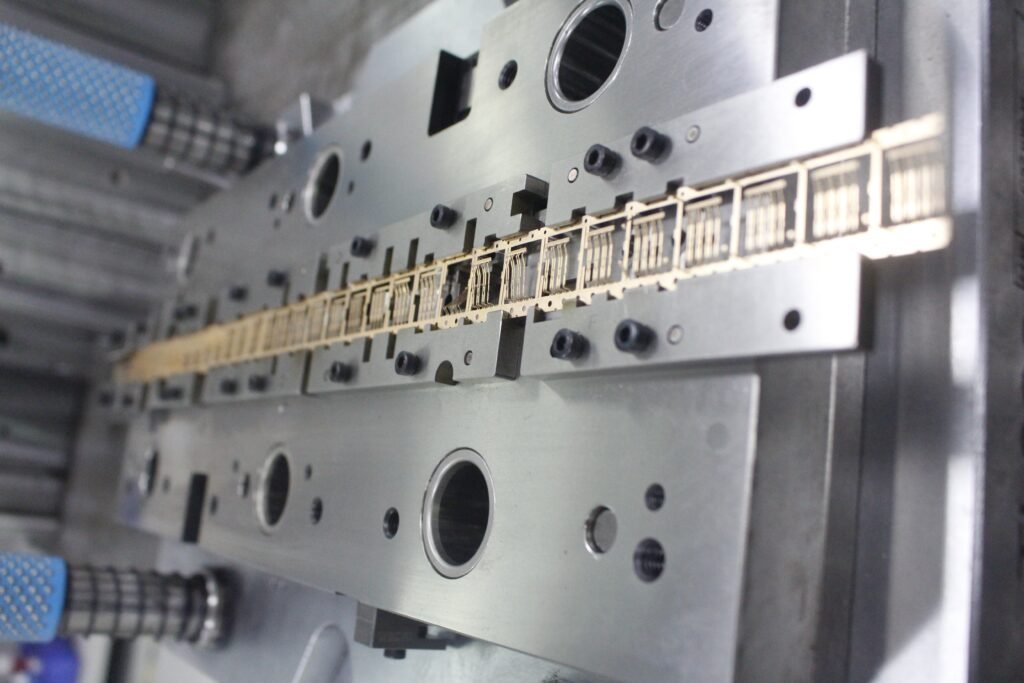
One of our customers — a European connector manufacturer — came to us with a design for a 127-station progressive die for copper alloy lead frames. Their previous supplier had skipped DFM and built to print. Result: 14% scrap rate at Station 73 due to a pitch accumulation error that wasn’t caught until T3 samples.
We rebuilt the tooling with a full DFM review. Key changes made before cutting steel:
- Introduced 3 pilot correction stations at critical intervals
- Reduced tolerance on carrier strip width from ±0.03mm to ±0.01mm to prevent strip wander
- Moved a forming station 2 positions earlier to reduce springback compensation error
T1 scrap rate: 1.8%. Production scrap rate after fine-tuning: under 0.4%.
Start Your DFM Review Today
DFM is not a cost center — it’s a cost reduction tool. Every hour spent on DFM before tooling begins saves days of rework afterward.
At PreciseWorksPlus, we offer complimentary pre-quote DFM scans for all new tooling inquiries. If you have a project in planning or a drawing you’d like reviewed, send it to us directly.
📧 Contact: rockie.liu@preciseworksplus.com
We typically respond within 24 business hours with a DFM summary and preliminary quote.
Data sources: Internal project database (PreciseWorksPlus, 2023–2025); Industry benchmarks from AMBA (American Mold Builders Association) tooling cost studies; Moldex3D application notes on warpage and sink mark prevention.