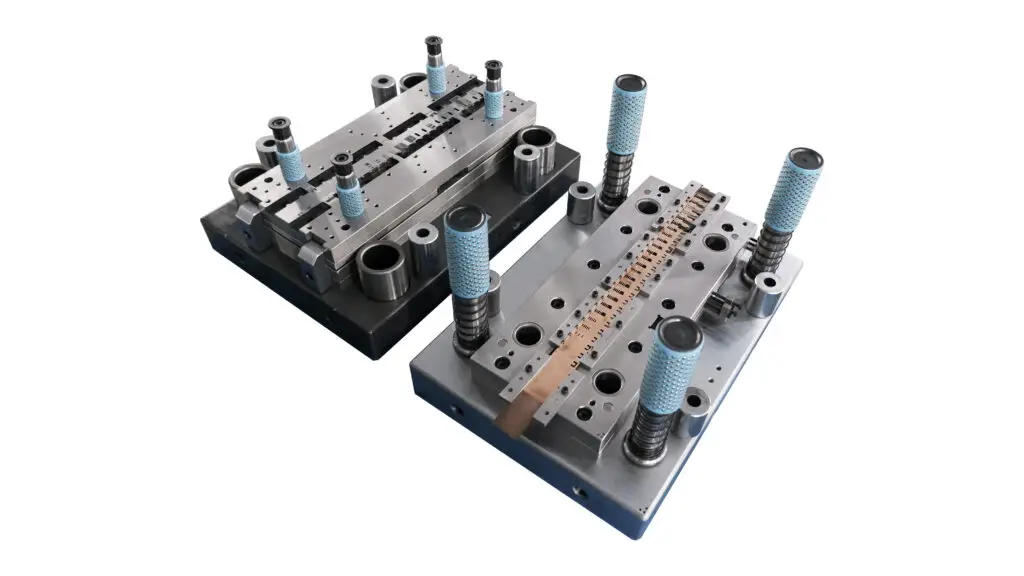
When it comes to stamping die manufacturing, accurately estimating the weight of a stamping die is of great significance. It plays a crucial role in production planning, cost – management, and shipping arrangements. Today, we’ll share effective methods for estimating stamping die weights, and also explain why our factory should be your top choice in this regard.
Step – by – Step Guide to Estimating Stamping Die Weight
Case 1: When Only the Length, Width, and Height of the Die are Known
If you already know the length (Length), width (Width), and height (Height) of the stamping die, the process becomes more straightforward.
First, identify the material of the die. Most stamping dies are made of steel, and the density (Density) of steel is approximately 7.85 t/m³.
However, the weight calculation isn’t just a simple multiplication of volume and density. You also need to consider a weight coefficient (Coefficient) to account for factors like the complexity of the die structure, presence of additional components, etc. A common range for this coefficient is between 1.1 – 1.3. For a relatively simple die, you might use a coefficient closer to 1.1, while for a more complex one, a value closer to 1.3 would be appropriate.
The formula to calculate the weight (Weight) of the die is:
Weight = Length × Width × Height × Density × Coefficient × 10⁻⁹
Here, Length, Width, and Height should be in millimeters (mm), Density is in t/m³, and the resulting Weight will be in tons (t). The factor of 10⁻⁹ is used to convert the volume from mm³ to m³.
Case 2: When Starting from Stamping Part Dimensions
If you start with the dimensions of the stamping part, here’s what you do:
First, note down the length (Length2) and width (Width2) of the flattened stamping part, as well as its height (Height1). For different types of dies, the die dimensions are calculated differently. For example, in the case of a drawing die, when Length2 ≥ 500mm, typically the die length (Length3) = Length2 + 600, the die width (Width3) = Width2 + 450, and the die height (Height3) = Height1 + 600 (all in mm). Specific rules apply to other die types and different size ranges as well.
After determining the die dimensions (Length3, Width3, Height3), you follow the same process as above. Identify the density of the die material (7.85 t/m³ for steel), select an appropriate weight coefficient (Coefficient) based on the die complexity, and use the formula:
Weight = Length3 × Width3 × Height3 × Density × Coefficient × 10⁻⁹
Further question?
If you have any stamping die needs, whether it’s estimating the weight, manufacturing, or custom – designing, visit our website preciseworksplus.com. Our professional team is eager to assist you. Let’s collaborate to bring your metal tooling projects to fruition!