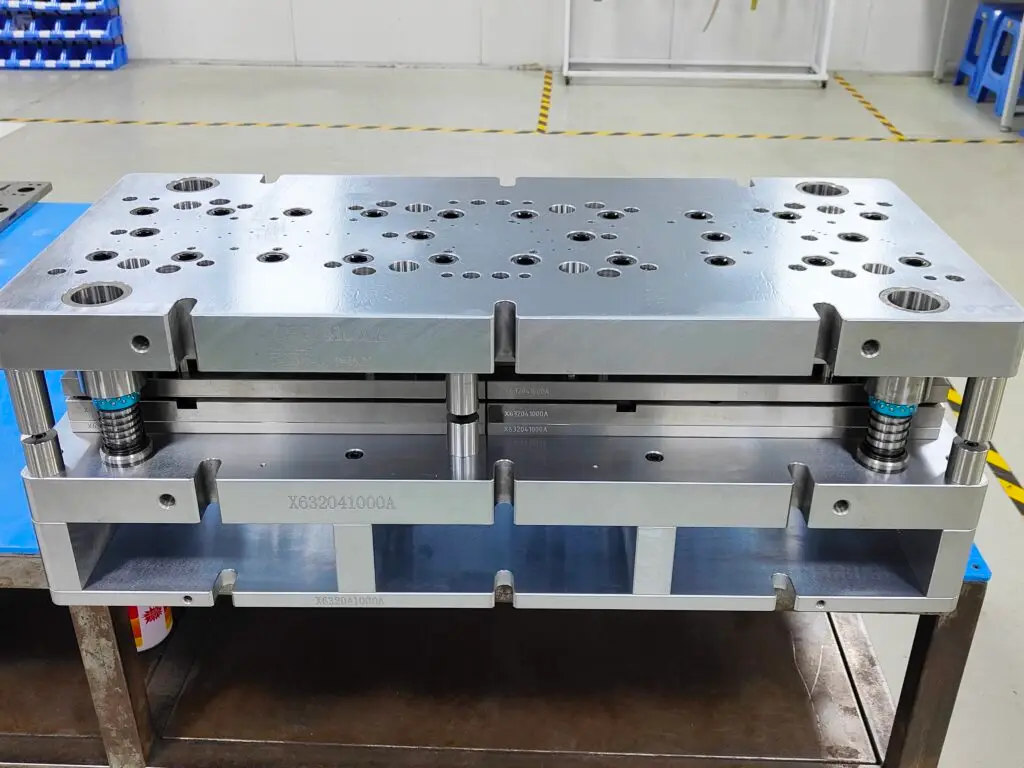
In the production and manufacturing of precision stamping die, the die shoes(punch set and die set), as a core load-bearing component, its material selection and surface treatment directly affect the tooling’s precision retention, service life, production efficiency, and even the quality of the final product. Many industry partners often struggle with: Should the die shoes be made of C45# steel or aluminum? If choosing aluminum, how to select between 6061 and 7075? Should the surface treatment be chrome plating or anodizing? This practical guide will clarify these questions at once and help you accurately match your needs!
I. Core Dilemma: How to Choose Materials for Precision Mold Bases? C45# Steel vs 6061 Aluminum vs 7075 Aluminum
The selection of die shoes materials mainly revolves around four core dimensions: mold precision requirements, load-bearing capacity, production rhythm, and cost budget. Different materials vary significantly in mechanical properties, processing difficulty, and application scenarios. Blind selection can easily lead to premature mold failure or cost waste. Below is a direct comparative analysis:
1. Classic Choice: C45# Steel
C45# steel (medium-carbon high-quality structural steel) is a “veteran mainstay” in the field of die shoes. With stable performance, it has become the first choice for many conventional precision molds, especially suitable for scenarios requiring high rigidity and wear resistance.
Core Advantages: ① Balanced mechanical properties, moderate strength and hardness; after quenching and tempering, rigidity and deformation resistance are far superior to aluminum alloys; ② Excellent wear resistance, capable of withstanding long-term repeated mold clamping impacts and having a long service life; ③ Mature processing technology, low difficulty in turning, milling, grinding and other processing, and easy control of dimensional accuracy; ④ High cost performance, medium level of raw material and processing costs, suitable for mass-produced conventional precision molds.
Application Scenarios: Mold bases for large and medium-sized precision injection molds and stamping molds; molds that need to bear large clamping force and long-term high-frequency production; production scenarios requiring die shoes service life exceeding 500,000 cycles.
Notes: Relatively heavy weight, which will increase the overall weight of the mold and have higher requirements on the load-bearing capacity of injection molding machines and stamping machines; subsequent heat treatment (such as quenching and tempering) is required to improve performance, adding an additional process link.
2. Lightweight Choice: 6061 Aluminum Alloy
6061 aluminum alloy (aluminum-magnesium-silicon alloy) is a common material for lightweight transformation in the mold industry. It is especially suitable for scenarios sensitive to mold weight and fast production rhythm, and has been increasingly used in precision electronics, auto parts and other fields in recent years.
Core Advantages: ① Significant lightweight, with a density of only about 1/3 of steel, which can greatly reduce the mold weight, reduce equipment load, and facilitate the handling and installation of the mold; ② Excellent processing performance, low cutting resistance, enabling high-speed processing and shortening the die shoes processing cycle; ③ Good corrosion resistance, not easy to rust in humid environments, and no additional anti-rust treatment is required; ④ Lower cost than 7075 aluminum alloy, high cost performance, suitable for lightweight molds with moderate strength requirements.
Application Scenarios: Mold bases for small and medium-sized precision injection molds and thin-walled product molds; molds for automated production lines that require quick mold change and high-frequency handling; molds for precision small electronic parts (such as mobile phone accessories and connector molds).
Notes: Strength and rigidity are not as good as C45# steel, not suitable for large and medium-sized molds that need to bear large clamping force; slight deformation may occur in long-term high-temperature environments, so production temperature needs to be controlled.
3. High-Strength Lightweight Choice: 7075 Aluminum Alloy
7075 aluminum alloy (aluminum-zinc-magnesium-copper alloy) is a “high-strength representative” among aluminum alloys. Its strength is close to that of ordinary steel, and it retains the lightweight advantage of aluminum alloys, making it suitable for lightweight molds with high requirements on precision and strength.
Core Advantages: ① Extremely high strength; after aging treatment, the tensile strength is far higher than that of 6061 aluminum alloy, and even comparable to some low-carbon steels; ② Obvious lightweight advantage, weight is only 1/3 of C45# steel, balancing strength and lightweight requirements; ③ Good dimensional stability, small deformation after processing, and can maintain mold precision for a long time; ④ Excellent fatigue resistance, suitable for precision molds with long-term high-frequency production.
Application Scenarios: Mold bases for high-precision lightweight molds (such as precision medical device molds and high-end electronic component molds); die shoes for small and medium-sized stamping molds that need to bear a certain load; precision molds with extremely high requirements on mold precision retention (such as tolerance within ±0.005mm).
Notes: High cost, raw material and processing costs are higher than 6061 aluminum alloy and C45# steel; slightly higher processing difficulty, requiring professional processing technology control; corrosion resistance is not as good as 6061 aluminum alloy, so it is recommended to match with appropriate surface treatment.
Quick Reference Table for Material Selection
| Material Type | Core Advantages | Application Scenarios | Cost Level |
| C45# Steel | High strength, good rigidity, excellent wear resistance, mature technology | Large and medium-sized precision die shoes, high-load, long-life molds | Medium |
| 6061 Aluminum Alloy | Lightweight, fast processing, good corrosion resistance, high cost performance | Small and medium-sized lightweight die shoes, automated production line molds | Medium-Low |
| 7075 Aluminum Alloy | High strength, lightweight, dimensional stability, excellent fatigue resistance | High-precision lightweight die shoes, high-demand precision molds | High |
II. Finishing Touch: Common Surface Treatment Processes for Precision Mold Bases
After selecting the right material, an appropriate surface treatment can make the die shoes “even better”—it not only improves wear resistance and corrosion resistance but also optimizes demolding performance and extends service life. For different materials, the common surface treatment processes are as follows:
1. Chrome Plating: “Wear-Resistant Standard” for Steel Mold Bases
Chrome plating is the most common surface treatment process for C45# steel die shoes, divided into hard chrome plating and decorative chrome plating. Among them, hard chrome plating is the most widely used in precision molds.
Core Functions: ① Improve wear resistance: Hard chrome plating has high hardness (HV800-1000), which can greatly reduce the friction loss between the die shoes and guide pillars and bushes, and avoid scratches and wear during long-term use; ② Enhance corrosion resistance: The dense chrome plating layer can isolate air, moisture and oil, preventing the steel die shoes from rusting; ③ Optimize surface smoothness: The flat and smooth surface of the plating layer can improve the movement precision of the die shoes and reduce mold clamping resistance.
Application Scenarios: Matching surfaces of guide pillars and bushes of C45# steel die shoes; die shoes components that need long-term high-frequency movement; humid or oily production environments.
2. Anodizing: “Exclusive Optimization Solution” for Aluminum Alloy Mold Bases
Anodizing is the core surface treatment process for aluminum alloy die shoes. It can form a dense oxide film on the aluminum surface, and at the same time, different colors can be achieved through dyeing, taking into account functionality and decoration. The anodizing effect varies slightly between 6061 and 7075 aluminum alloys:
– 6061 Aluminum Alloy: After anodizing, the oxide film has good uniformity and excellent corrosion resistance. It can be dyed into various colors such as black, natural color, and champagne gold, suitable for lightweight die shoes with certain appearance requirements;
– 7075 Aluminum Alloy: Due to the presence of alloying elements such as copper, the oxide film after anodizing is dark in color (mostly dark gray or black), but the oxide film has high hardness and better wear resistance than 6061 aluminum alloy, suitable for high-precision aluminum die shoes with high wear resistance requirements.
Core Functions: ① Improve wear resistance: The high-hardness oxide film can prevent the surface of the aluminum alloy die shoes from being scratched and worn; ② Enhance corrosion resistance: Isolate external media and prevent aluminum alloy from oxidizing and rusting; ③ Optimize demolding performance: The smooth surface of the oxide film can reduce friction with other mold components and improve mold clamping smoothness; ④ Decoration: Can be dyed according to needs to meet the appearance requirements of different scenarios.
3. Other Common Surface Treatment Processes
– Nitriding Treatment: Mainly used for C45# steel die shoes. A nitrided layer with extremely high hardness is formed through nitriding, and its wear resistance and fatigue resistance are far superior to chrome plating. Suitable for precision die shoes with extremely high service life requirements (such as molds with more than one million production cycles);
– Black Oxide Treatment: A low-cost anti-rust treatment process, suitable for non-matching surfaces of C45# steel die shoes. It can play a basic anti-rust role and has a black appearance;
– Coating Treatment: Such as Teflon coating, mainly used for die shoes components that require excellent demolding performance. It can reduce material adhesion and improve production efficiency.
III. Summary: Accurate Matching to Avoid Detours
1. If pursuing high rigidity, long service life and moderate budget: Choose C45# steel die shoes, matched with chrome plating or nitriding treatment;
2. If pursuing lightweight, fast processing and moderate strength requirements: Choose 6061 aluminum alloy die shoes, matched with anodizing treatment;
3. If pursuing high precision and high-strength lightweight: Choose 7075 aluminum alloy die shoes, matched with anodizing (black/dark gray) treatment.
In fact, there is no absolute “best” choice for precision die shoes selection, only the “most suitable” one. The key is to judge based on comprehensive factors such as your own mold size, production load, precision requirements, and cost budget.
If your tooling project is facing die shoes selection difficulties, such as not knowing how to balance strength and lightweight, or being unsure which surface treatment is most suitable for the production scenario, please feel free to leave a message or contact us privately! Our professional team will provide you with one-on-one selection solutions, accurately match your needs, and help your mold production be efficient, stable and low-cost!