As the global shift toward clean energy accelerates, fuel cells have emerged as a cornerstone technology for zero-emission transportation, stationary power, and aerospace applications. At the heart of high-performance proton exchange membrane fuel cells (PEMFCs) lies the metallic bipolar plate (MBP) — a component that demands ultra-precision, durability, and cost-efficiency to scale production. For fuel cell manufacturers, the right stamping die partner can make or break your ability to meet market demand while maintaining uncompromised quality.
With years of specialized experience in metallic bipolar plate stamping dies, we’re here to solve your most pressing production challenges. Let’s explore why precision stamping is the backbone of MBP manufacturing — and how our expertise can elevate your fuel cell stack performance.
Why Stamping Dies Are Critical for Metallic Bipolar Plate Success
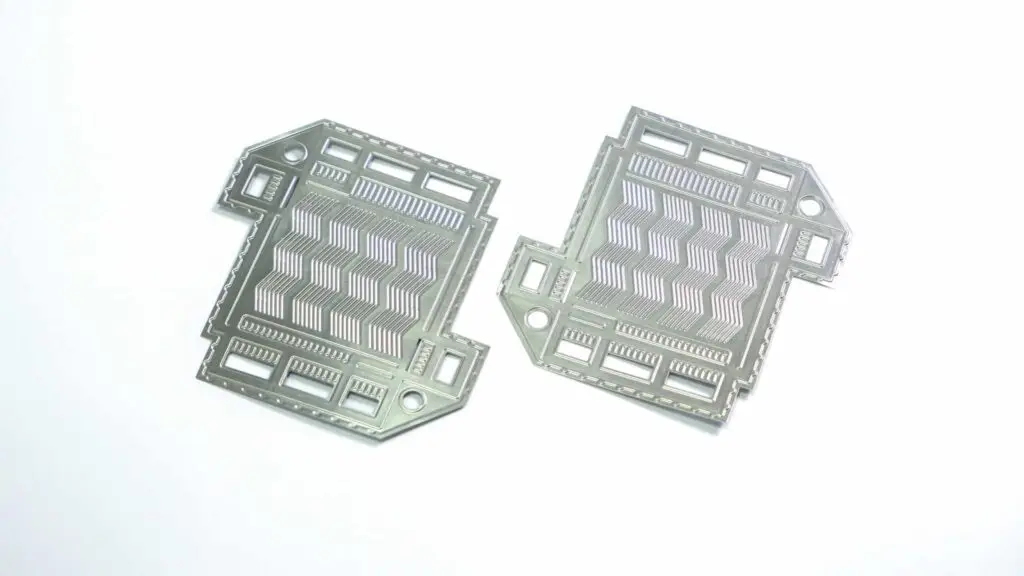
Metallic bipolar plates require exacting standards: ultra-thin material handling (0.1-0.3 mm stainless steel, titanium, or aluminum), complex flow field geometries (serpentine, parallel, interdigitated), and tight tolerances (±0.01 mm for flow channel depth). Stamping stands out as the most cost-effective, high-volume manufacturing method for MBPs — but only with dies engineered for the unique demands of fuel cell technology:
- Consistency at Scale: Stamping produces 1,000+ MBPs per hour with uniform flow channels, ensuring consistent gas distribution and electron conduction across every plate. Poorly designed dies lead to uneven channels, leak risks, and reduced fuel cell efficiency.
- Material Integrity: Thin metallic sheets (e.g., 316L stainless steel, Ti-6Al-4V) are prone to wrinkling, cracking, or springback during forming. Our dies minimize material stress, preserving conductivity and corrosion resistance.
- Cost Optimization: Compared to etching (high per-unit costs) or machining (low throughput), stamping reduces production costs by 30-50% for high-volume orders — a critical advantage in the competitive fuel cell market.
Our Expertise: Stamping Dies Tailored for Metallic Bipolar Plates
We don’t just build dies — we engineer solutions aligned with the unique needs of fuel cell manufacturers. Our specialized capabilities include:
1. Precision Engineering for Complex Flow Fields
Flow field design directly impacts fuel cell performance: uniform gas distribution reduces pressure drop, while optimized channel width (0.5-2 mm) and depth (0.3-1 mm) maximize reaction efficiency. Our team uses advanced CAD/CAM software and finite element analysis (FEA) to:
- Customize flow field geometries (serpentine, parallel, fork-shaped, or hybrid designs) based on your stack power requirements.
- Ensure die cavities match your MEA (membrane electrode assembly) dimensions for seamless stacking and sealing.
- Minimize tool wear with hardened steel (H13, S136) and PVD coatings, extending die lifespan to 500,000+ cycles.
2. Material-Specific Die Design
Different MBP materials demand tailored die solutions — and we have deep experience with all industry-standard metals:
- Stainless Steel (316L, 430): Dies with adjustable clamping force to prevent springback and oxide film damage (critical for post-coating conductivity).
- Titanium/Aluminum: Precision-ground punches and dies with smooth surfaces to avoid material tearing (especially important for low-ductility titanium).
- Coated Metals: Dies engineered to accommodate pre-coated sheets (e.g., TiN, graphene) without damaging the protective layer.
3. Tolerance Control & Quality Assurance
Fuel cell stacks rely on tight dimensional consistency: even minor deviations in plate thickness or channel geometry can cause gas leakage or increased contact resistance. Our quality process includes:
- In-die sensors for real-time monitoring of forming pressure and material thickness.
- Post-production inspection with CMM (Coordinate Measuring Machine) to verify tolerances (±0.005 mm for critical features).
- Compatibility testing with your stacking and welding processes to ensure seamless integration.
4. Scalability & Customization
Whether you’re producing prototype batches (100-1,000 units) or scaling to mass production (100,000+ units/year), our dies adapt to your needs:
- Rapid tooling for prototypes (4-6 weeks lead time) to accelerate your product development cycle.
- High-volume dies with automated feeding systems for integration into your production line.
- Custom modifications for unique stack designs (e.g., integrated coolant channels, asymmetrical flow fields).
Why Partner With Us?
In the fast-growing fuel cell industry, speed-to-market and quality are non-negotiable. Our clients choose us for:
- Specialized Focus: We don’t spread ourselves thin — our entire team is dedicated to stamping dies for energy components, with a deep understanding of MBP performance requirements.
- Proven Track Record: We’ve supplied dies to leading fuel cell manufacturers for automotive, stationary power, and aerospace applications, with 99% on-time delivery and zero quality-related production halts.
- Collaborative Approach: We work with your engineering team from concept to production, offering design for manufacturability (DFM) advice to optimize your MBP design for stamping efficiency.
- Cost Transparency: No hidden fees — we provide detailed quotes that include die maintenance support and spare parts, ensuring long-term production stability.
Ready to Accelerate Your Metallic Bipolar Plate Production?
The fuel cell market is growing at 25%+ CAGR, and the demand for high-quality, cost-effective MBPs is skyrocketing. Don’t let subpar stamping dies slow down your growth.
Whether you’re developing a new fuel cell stack or looking to optimize existing production, our precision stamping dies deliver the consistency, efficiency, and durability you need. Contact us today to discuss your project:
- Share your MBP material, flow field design, and production volume.
- Receive a customized die design proposal and quote within 3 business days.
- Get a sample batch stamped with our dies to test performance in your stack.
Let’s build the tools that power the clean energy revolution — together.