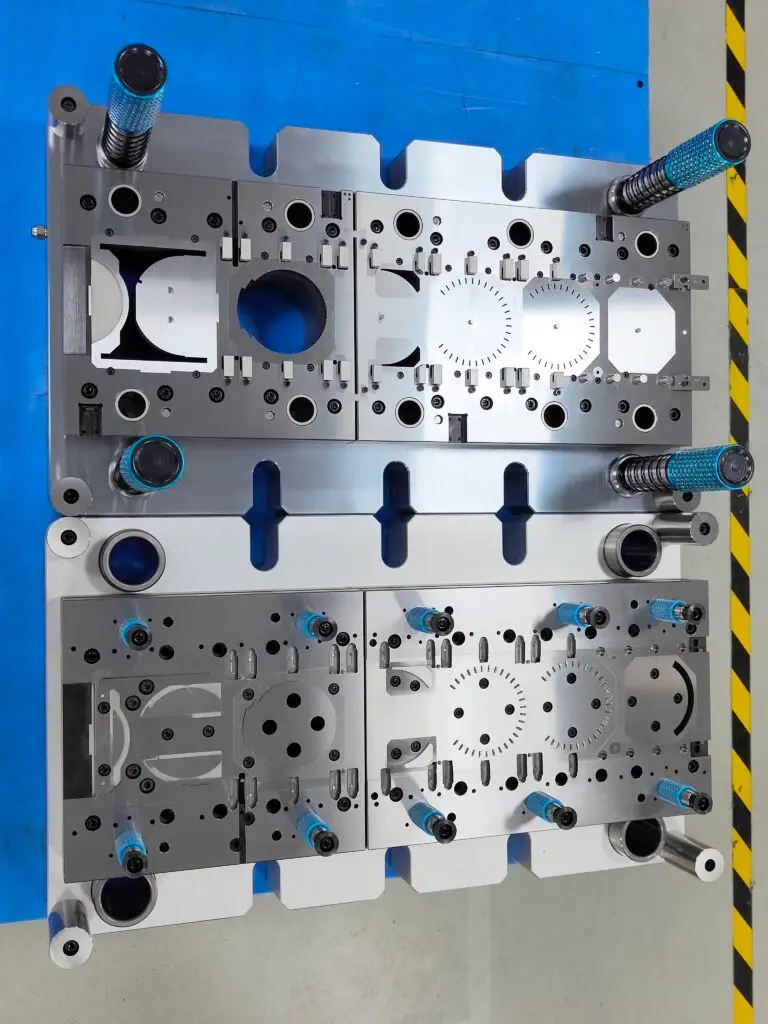
How to Choose the Right Asian Mold Supplier in 2026: A Buyer’s Guide Amid Global Supply Chain Restructuring
The global precision mold supply chain is undergoing its most significant transformation in decades. Tariff shifts, nearshoring trends, and the rise of manufacturing hubs outside China are reshaping how European and North American procurement teams evaluate Asian suppliers. For buyers of automotive connector molds, lead frame tooling, and high-precision stamping dies, the question is no longer simply “China or not China” — it’s about building a resilient, multi-source supplier strategy that balances cost, quality, and delivery certainty.
This guide walks through the key factors Western buyers should weigh when selecting an Asian mold supplier in today’s environment, with real data points and actionable frameworks.
1. The New Geography of Asian Mold Manufacturing
For two decades, the playbook was simple: source from China’s Pearl River Delta, where clustered ecosystems in Dongguan, Shenzhen, and Kunshan delivered molds faster and cheaper than anywhere else. That playbook is being rewritten.
Here’s a snapshot of how the three primary Asian supply bases compare in 2026:
| Фактор | China (Dongguan / Kunshan) | Vietnam | Mexico (Nearshoring Hub) |
|---|---|---|---|
| Typical Mold Lead Time | 6–10 weeks | 10–14 weeks | 8–12 weeks |
| Precision Capability (Tolerance) | ±0.002 mm (proven) | ±0.005–0.01 mm (developing) | ±0.005 mm (growing) |
| Mold Base Cost (Index) | 100 (baseline) | 85–95 | 120–140 |
| Supply Chain Maturity | ★★★★★ Fully integrated | ★★★☆☆ Growing | ★★★☆☆ Import-dependent |
| Key Risk Factor | Tariff exposure (US Section 301) | Skilled-labor shortage | Higher unit cost |
| Freight to US Midwest | 25–35 days (ocean) | 30–40 days (ocean) | 3–5 days (truck) |
Key takeaway: China retains an overwhelming advantage in precision, speed, and ecosystem maturity. Vietnam and Mexico are viable for lower-complexity tooling or when tariff mitigation is the overriding priority — but neither comes close to matching China’s mold-making depth today.
2. Beyond Price: The 5 Criteria That Actually Predict Supplier Performance
Too many RFQs reduce supplier selection to a single number on a quote sheet. Experienced buyers know that the real cost of a mold is determined by what happens after the purchase order is signed. Here are the five criteria that separate reliable partners from costly mistakes:
- Engineering Depth. Does the supplier have in-house DFM (Design for Manufacturability) capability? A supplier who can review your part design and propose gate location changes, draft-angle adjustments, or material substitutions before cutting steel will save you weeks of trial-and-error. This is especially critical for automotive connectors, where micro-tolerances on terminal cavities can make or break a mold.
- Standard Component Strategy. Ask what brand of mold base, ejector pins, and guide components they use. Top-tier suppliers offer tiered options — Agathon (Swiss, premium), Meusburger (Austrian, mid-to-high), or MISUMI (Japanese, economical) — and let you choose based on your tool-life target. A supplier who only stocks one brand may be optimizing for their margin, not your application.
- Wire EDM & Grinding Capacity. Precision molds live and die by wire EDM accuracy. Verify the supplier’s wire-cutting machine brand (Sodick, Mitsubishi, Seibu are benchmarks), the number of machines on the floor, and the current backlog. In China’s Dongguan region, wire EDM machine lead times have stretched to 10 months — a supplier who already has capacity on the floor is worth more than one promising a faster quote.
- Quality Documentation Package. A professional mold supplier delivers more than steel. They deliver a complete documentation set: 3D CAD models, material certificates, heat-treatment records, CMM inspection reports, and a tryout report with dimensional conformity data. If a supplier hesitates to commit to this in writing, walk away.
- Communication & English Proficiency. This is the silent killer of offshore mold projects. A supplier whose engineering team can read your 2D drawing notes in English — and respond with clear technical feedback — eliminates the translation bottleneck that causes 80% of project delays. Test this during the quotation phase: send a deliberately complex drawing note and see how they handle it.
3. The Cost-Quality Matrix: Where You Actually Save Money
The temptation is to rank suppliers by quoted mold price. But the total cost of ownership (TCO) tells a very different story — especially for molds expected to run millions of shots.
| Cost Driver | Low-Bid Supplier | Mid-Tier (Certified) | Premium Partner |
|---|---|---|---|
| Initial Mold Price (16-cavity connector mold) | $18,000–22,000 | $28,000–35,000 | $40,000–55,000 |
| Expected Tool Life (shots) | 500K–1M | 3M–5M | 10M+ |
| Cost per 100K Shots (amortized) | $2,000–4,400 | $560–1,170 | $400–550 |
| Typical Downtime (unscheduled maintenance/year) | 60–120 hours | 20–40 hours | <10 hours |
Data sourced from a composite of real-world connector mold projects in automotive Tier-1 supply chains, normalized for a 16-cavity terminal mold with 0.30 mm material thickness.
The math is clear: for a mold running 500K shots per year, the “cheap” option costs 4–11× more per shot than a premium mold over a 3-year horizon. Procurement teams that evaluate molds purely on upfront price are leaving money on the table — and the production floor will pay for it in unplanned downtime.
4. The Hidden Lever: Standard Component Branding as a Negotiation Tool
Here’s a tactic most buyers overlook. When you receive a quotation, ask the supplier to break out which standard components they’ve specified — mold base, guide pins, ejector sleeves, limit switches — and at what brand tier. Then use this as a negotiation lever:
- Demand Agathon or Meusburger for critical guide elements if you need 5M+ shot life. The price premium on components (~8–15% of total mold cost) is trivial compared to the tool-life gain.
- Accept MISUMI for non-critical components like ejector pins and springs — the cost saving is real and the quality is perfectly adequate for these locations.
- Red-flag test: If the supplier can’t name the brand of their mold base steel or their guide components on the spot, they’re likely buying from whoever is cheapest that week — which means you can’t replicate the mold later with consistent quality.
This is precisely how PreciseWorks Plus structures every quotation: our buyers see a line-item breakdown of exactly which brand goes where, and why. It transforms a black-box quote into an engineering conversation.
5. Building a Multi-Source Strategy That Actually Works
The smartest Western buyers aren’t abandoning Asia — they’re diversifying within it. A practical framework for 2026:
- Tier 1: Core high-precision molds (lead frames, multi-cavity connectors). Stick with established Chinese suppliers in Dongguan or Kunshan. The precision ecosystem — wire EDM shops, grinding specialists, heat-treatment facilities — simply doesn’t exist at the same density anywhere else.
- Tier 2: Medium-complexity tooling (brackets, simple housings). Consider Vietnam or a nearshore Mexican partner if tariffs are a material cost factor. The simpler the mold geometry, the less the precision gap matters.
- Tier 3: Spare parts and wear components. Source locally or from the same Asian supplier who built the original mold. Cross-sourcing wear components from a different supplier is asking for fitment headaches.
This tiered approach protects against single-point-of-failure risk while concentrating precision work where the capability genuinely exists.
What This Means for Your Next RFQ
If you’re evaluating Asian mold suppliers in 2026, add these three questions to your RFQ template:
- “Please provide a DFM report with your quotation, including at least three specific design recommendations for improving moldability or tool life.”
- “List the brand and grade of every standard component in this mold assembly, from mold base to ejector pins.”
- “What is your current wire EDM machine backlog, and what is your contingency plan if a machine goes down mid-project?”
A supplier who answers all three confidently and in detail — in clear English — is worth a second conversation. A supplier who dodges or gives vague answers just failed the most important test.
Need a Mold Supplier Who Checks Every Box?
На сайте PreciseWorks Plus (Dongguan Shuangshun Precision Mold Co., Ltd.), we specialize in high-precision progressive stamping dies and plastic injection molds for the automotive connector industry. We serve customers across Europe, North America, and Mexico — and every quotation includes a detailed DFM report, transparent component-brand breakdown (Agathon / Meusburger / MISUMI), and full quality documentation.
Our new Chengdu facility, equipped with Yamada and KYORI high-speed presses, extends our capacity for precision stamping tooling — giving Western buyers a reliable, scalable partner in Asia’s most mature mold-making ecosystem.
Contact us for a quotation or DFM review:
📧 rockie.liu@preciseworksplus.com
🌐 preciseworksplus.com
PreciseWorks Plus — Precision Molds. Global Delivery.
Data Sources: China Mold Industry Association 2025 Annual Report; U.S. International Trade Commission Section 301 tariff data (2026); internal project data from PreciseWorks Plus mold delivery records (2023–2026); VDMA German Engineering Federation precision tooling benchmark (2025).